Project Overview
I worked in a collaborative and cross-functional team to design and fabricate neural probes tailored for electrochemical serotonin detection. By leveraging SU-8 photoresist as a structural substrate and UV-lithography for patterning, we are developing a biocompatible, robust tool capable of monitoring neurotransmitter dynamics with high spatial resolution.
The Challenge
Serotonin plays a critical role in mood, cognition, and neurological disorders, yet monitoring it in real-time remains a challenge. Traditional metal electrodes are often too rigid, leading to tissue scarring, while existing flexible probes can lack the structural integrity needed for deep-brain insertion. The goal was to bridge that gap: creating a probe that is mechanically stable yet biocompatible for long-term sensing.
The Solution: Why SU-8?
We chose SU-8 (an epoxy-based negative photoresist) for its unique properties:
- Mechanical Strength: High Young’s modulus allows for thin, needle-like geometries that can penetrate tissue without buckling.
- Chemical Inertness: Ensures the probe remains stable in the corrosive biological environment.
- Process Versatility: Enables the integration of multi-layer metal traces (Gold/Platinum) for the sensing electrodes.
Microfabrication Pipeline
The fabrication was carried out in a Class 100/1000 cleanroom environment, utilizing a multi-mask lithographic process:
- Substrate Preparation: Silicon wafer cleaning and dehydration bake.
- Base Layer: Spin-coating and curing the initial SU-8 structural layer.
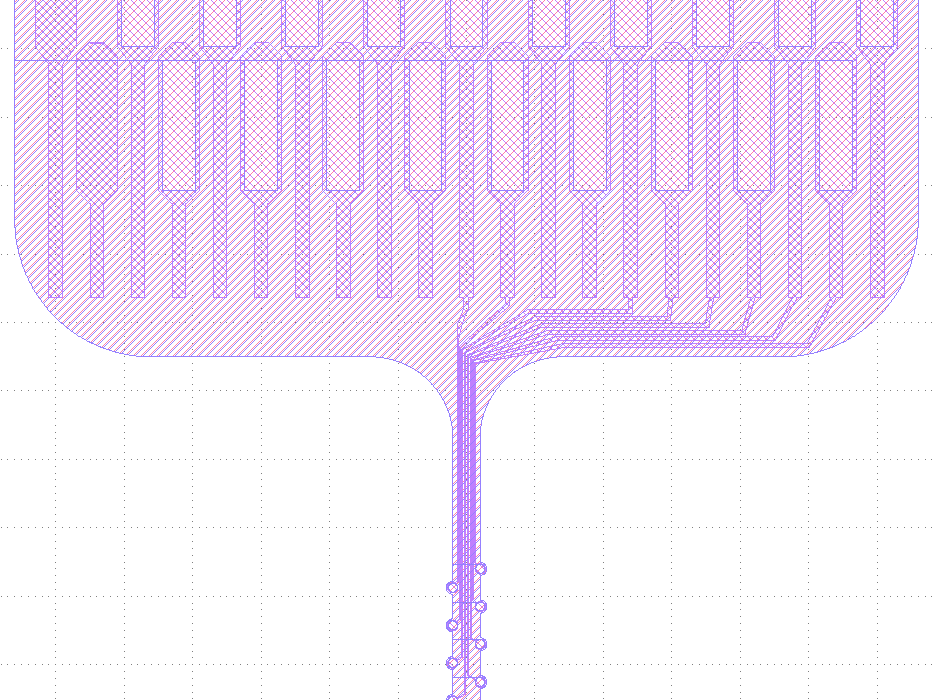
- Metallization: Sputter deposition and lift-off patterning of 8 Platinum (Pt) micro-electrodes.
- Insulation & Passivation: Application of a top SU-8 encapsulation layer, leaving only the sensing “hotspots” and bond pads exposed.
- Release: Final development and sacrificial layer etching to release the individual flexible probes.
Key Technical Specs: The resulting probes featured a shank width of <200μm, minimizing displacement during neural insertion. It also used edge electrodes rather than center electrodes to enhance selectivity and reduce the impact of gial scaring from insertion.
Skills & Tools
- Design: CAD (Klayout) for mask design.
- Lithography: Mask aligners, UV exposure, and photoresist chemistry (SU-8 3000 series).
- Metrology: SEM (Scanning Electron Microscopy) for topography