Predictive Operations for Community Fabrication: A Stochastic Model
The Context Community makerspaces and local fabrication hubs are the lifeblood of the right-to-repair movement and grassroots engineering. However, these spaces operate under a unique constraint: they rely on heavily used consumer-grade hardware (such as FDM 3D print farms) maintained almost entirely by a finite pool of volunteer labor. When machines inevitably fail, the system is bottlenecked not by the cost of parts but by the availability of human operators.
The Problem Relying on reactive, corrective maintenance leads to catastrophic machine failures that require massive volunteer time investments (e.g., 10+ hours to rebuild a damaged hotend). Conversely, over-scheduling preventive maintenance unnecessarily drains the volunteer time budget, leading to burnout. The challenge is finding the mathematical “sweet spot” that maximizes hardware availability without exceeding a strict annual labor budget.
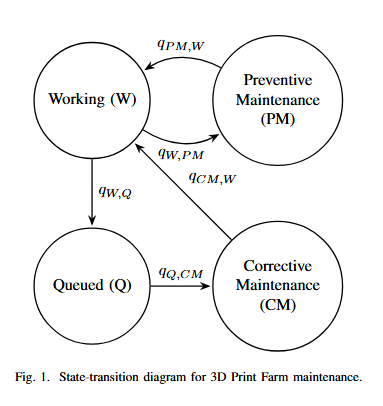
The Architecture: To solve this, I modeled the print farm’s operational lifecycle as a 4-state Continuous-Time Markov Chain (CTMC):
- Working: The baseline operational state.
- Queued: A failed state waiting for volunteer triage.
- Preventive Maintenance (PM): Proactive, low-time-cost servicing.
- Corrective Maintenance (CM): Reactive, high-time-cost repair.
Because formal academic literature on specific failure rates for consumer print farms is sparse, the model’s transition rates were heuristically parameterized using a synthesis of community-reported grey literature and standard makerspace operational norms.
The Solution: Due to the complexity of analytically solving for the stationary distribution under a hard time-budget constraint, I engineered a Discrete Event Simulation (DES) in Python. The simulation runs an 8,760-hour (1-year) operational cycle, sweeping through a range of preventative maintenance frequencies.
By applying a penalty-based objective function to the simulation outputs, the system successfully identifies the optimal PM pull-rate. This provides a prescriptive, data-driven schedule that preempts catastrophic failures while keeping total volunteer hours strictly under budget.
Core Competencies Demonstrated:
- Systems Engineering: Translating physical hardware operations and human labor constraints into a mathematically rigorous state-machine architecture.
- Stochastic Modeling: Applying Markovian processes to predict and manage system reliability over time.
- Computational Simulation: Designing and executing a Discrete Event Simulation in Python (NumPy/Pandas) to bypass analytical limitations.
- Heuristic Parameterization: Extracting defensible baseline metrics from decentralized data sources when formal datasets are unavailable.